


Conversations at Midnight #15: Mom, Luke Left the Door Open!


Sometimes, in the middle of studying one passage, another one taps you on the shoulder and says, "Hey, come over here for a minute." This week, it was an upper room in Jerusalem that caught my attention and drew me away from Paul's letters—pen in hand—to simply breathe. Breathe in the heavenly wonder and perhaps a few aromas that were a little more earthy?
As a pastor's wife, having organized more church functions than I can count, I can confidently assert that fitting 120 believers into one upstairs room may have been Pentecost's first miracle. For no less than ten days! No air conditioning. No indoor plumbing. No showers. Very little personal space. Luke's comment that they were continually united in prayer sounds even more incredible. Perhaps the greatest miracle was that 120 people could share one upstairs room for that long without branching off into their own denominations.
Maybe that's why I love this story so much. I used to picture the upper room with soft lighting, harps playing, and remarkably clean people. Luke probably would have described it as humid, crowded, noisy, and full of bewildered people trying to figure out what Jesus meant when He told them to wait. Wait for what?
As I read, one seemingly minor detail refused to let me hurry past. Luke tells us that Mary, the mother of Jesus, and the women who had faithfully followed Him throughout His ministry were also there—waiting alongside the Twelve and Jesus' family.

Luke didn't have to tell us that. He could have simply written, "About 120 disciples gathered." Instead, he opened a door, as if to say, "Come on in. See who's here."
Luke strikes me as the sort of person who listens well. He wasn't there when Jesus walked the dusty roads of Galilee, so he sought out those who were. He gathered their stories carefully, weaving them together so that, generations later, we could sit in the room with them. Some scholars have suggested one of those voices may even have belonged to Mary herself.
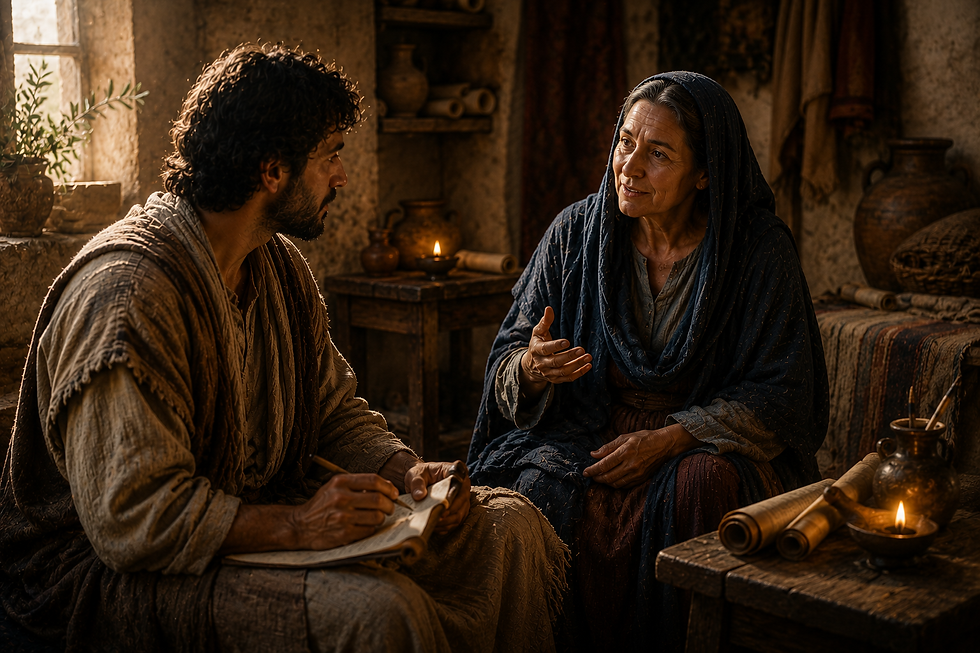
The more I read Luke, the more I appreciate the people he introduces us to, standing quietly at the edge of the Gospels, yet with their own stories. While others might have hurried past them, Luke slows down and gets to know them. He enters into Elizabeth's overflowing joy and preserves Mary's song. He pauses to celebrate Anna's lifelong worship but didn't forget the grieving widow of Nain. He lingers with busy Martha and her sister Mary, sitting at Jesus' feet in the posture of a disciple. He names Joanna. He remains at the cross with the women who refused to leave, and he meets them again at the empty tomb as the first witnesses to the resurrection. In Acts, he will soon introduce us to Lydia and Philip's four daughters, who prophesied.
So when Luke pauses in Acts 1 to tell us that the women were gathered in the upper room, I don't think it's incidental. It's exactly the sort of detail this careful listener—and attentive storyteller—wanted us to see.
Have you ever wondered what it would have felt like to be in that room?
Weeks earlier, they had watched Jesus die, received Him back from the grave, only to watch Him ascend into heaven. As awe-inspiring as that must have been, I wonder if, in another sense, it felt as though they had lost Him all over again?
My thoughts drift to Mary, who had watched her firstborn breathe His last. Most of these men had run away in fear. It was the women who had remained, standing faithfully nearby and holding her close. Did Peter find it difficult to meet her eyes? Did she simply embrace him as only a mother can?
Then my thoughts turn to Jesus' brothers. Their dying sibling had entrusted their mother's care, not to them, but to His good friend John—the last man standing. What conversations had taken place between then and now? What had changed?
Now they're all together in one room. Jesus' brothers are sitting beside Peter and John. Can you hear the awkward silences? Or perhaps there weren't any. Maybe there were quiet—or not so quiet—apologies, tears, and the kind of embraces that only grace can teach.
Redemption in real time.
Did Thomas ever whisper, "I should have believed Him sooner," as Mary simply reached over and squeezed his shoulder?
One seat in the room remained empty. Peter believed it needed to be filled.
Judas Iscariot's. His story had ended tragically, but grief rarely follows chapter breaks. Betrayal doesn't erase years of friendship. I wonder whose eyes filled with tears whenever his name was spoken. As Peter raised the subject, did he remember his own failings too?
Luke describes the room as ringing with prayer. But from a purely human perspective, I imagine something else as well. Meals. Stories. Laughter. Questions.
"What do you think Jesus meant when He said, 'Wait?'"
"I don't know."
"Do you think He meant here?"
"I think so."
"Well, I hope we got it right. Because if it arrives and we've gone out for bread, we will never hear the end of it."
Did James or John ever have to ask Peter to keep his sermons under an hour? I wonder how that went over.
And the women? Like Mary of Bethany before them, they positioned themselves exactly where Jesus had told His followers to be. Waiting. Hoping. Expecting. Trusting.
Though nobody knew what was coming, no one wanted to miss out
Suddenly...
Wind.
Fire.
Languages they had never learned.

Here's the detail that keeps capturing my attention: Luke doesn't say that tongues of fire rested only on the apostles. He has gone to the trouble of telling us who was in the room, and then he says, They were all filled with the Holy Spirit. Notice the word all.
Fire rested on the women's heads just as it did on the apostles'. The rushing wind that filled the entire house made no distinction, sweeping over them too. Filled with the Holy Spirit, they lifted their voices with everyone else in a cacophony of joyful declaration to pilgrims from every nation gathered under the sun for Shavuot—the Hebrew Festival of Weeks.
I find this breathtaking—not because it settles every debate, but because Luke wanted future generations to know they were there; waiting, praying, receiving, proclaiming. Right alongside the men.
Until that moment, everyone in that room was simply ordinary. Tired. Dusty. Still grieving. Still asking questions. Some had been brave. Most had not. Some may still have carried the sting of regret.
Did they have any idea that heaven was about to interrupt their ordinary lives once again? Only this time, there would be no going back.
The Kingdom of God seems strangely comfortable arriving in ordinary places among ordinary people: a stable, a carpenter's shop, fishing boats, a borrowed donkey, an upstairs room, an empty tomb. Shepherds, fishermen, soldiers, women—sisters, mothers, aunties, and daughters. Sometimes I wonder how many of us have read Acts 2 and imagined Pentecost as mostly about Peter? Perhaps Luke left the door open in hopes we'd find more?
That may be why this story settled so deeply into my bones this week. The first church wasn't born in perfect conditions with comfortable seating arrangements. It was birthed in close quarters, among surrendered hearts. The Spirit wasn't coming to build an institution, but a community. Even better, a family.
In that room—likely warm and crowded, certainly aromatic—history was about to change forever. Knit together in prayer, shoulder to shoulder were men... and women.
Luke noticed that detail. I think we should too.


Comments